Full-grain vs. Top-grain Leather: What's the Difference and Which Is Better?
“Full-grain” and “top-grain” sound like two ways of describing the same premium leather. They’re not. One keeps the hide’s natural surface intact, while the other is sanded and refinished to remove imperfections — a small manufacturing difference that changes how the leather looks, ages, and holds up over time.
That doesn’t automatically make top-grain leather a poor choice. Its smoother, more uniform surface can actually be more practical for sofas, car interiors, and other products where stain resistance and consistency matter. Full-grain leather takes the opposite approach: scars and variations remain visible, the surface changes with use, and a patina gradually becomes part of the material rather than something manufacturers try to prevent.
So the better choice depends on what you expect from the product. Below, we’ll compare full-grain vs. top-grain leather side by side, explain where genuine and bonded leather fit into the quality hierarchy, and look at which grade makes more sense for wallets, bags, sofas, and other everyday goods.
Full-Grain vs. Top-Grain Leather: What's the Difference?
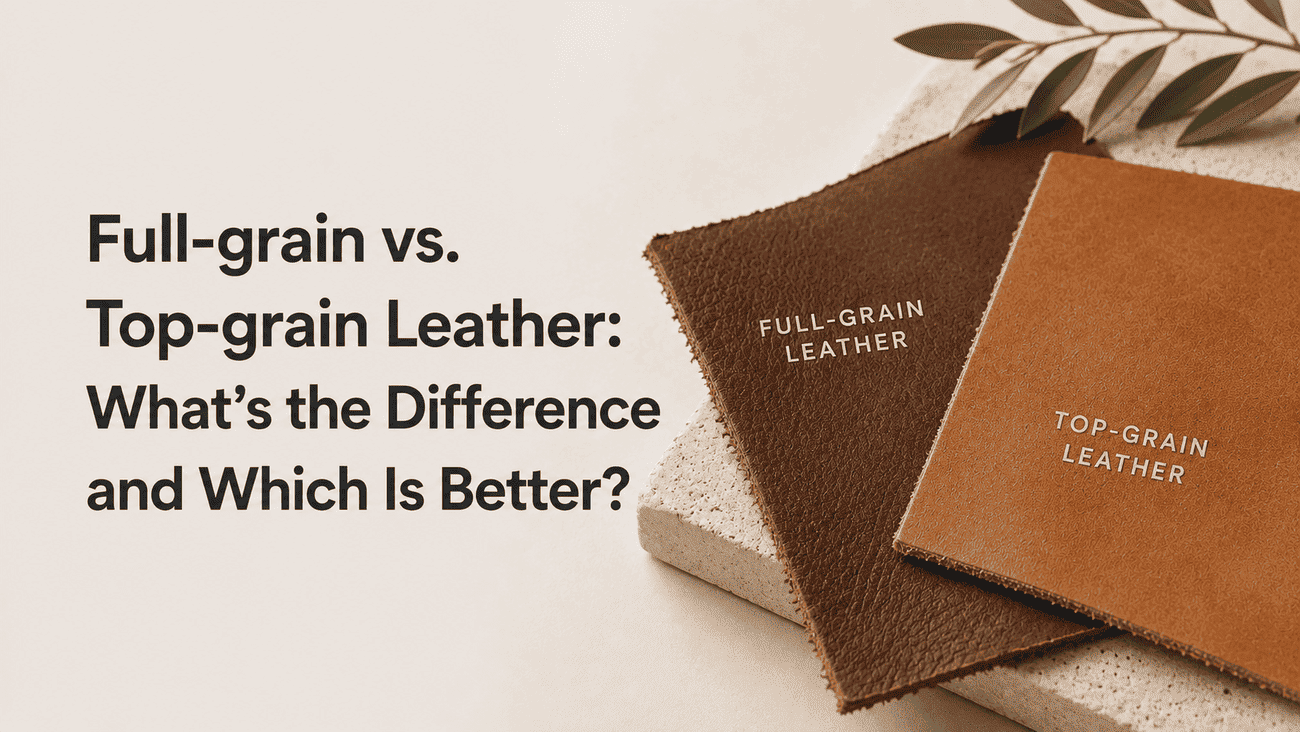
Full-grain leather keeps the hide's entire natural grain surface untouched, while top-grain leather has that surface lightly sanded (snuffed) and refinished for uniformity. As a result, full-grain leather is stronger and develops a patina; top-grain leather looks more consistent and costs less.
Here's the terminology twist: unaltered top-grain leather technically IS full-grain leather. Both terms describe how much of the grain survives processing. And as of 2026, grade language on US product pages remains a marketing claim, not a certified spec, since the FTC Leather Guides (1996) do not have the force of law.
The difference starts with hide anatomy. The tight-fibered grain layer sits above the looser corium, and this distinction drives every practical difference below.

What Is Full-Grain Leather?
Full-grain leather is defined by the ISO 15115 vocabulary as leather "having kept its entire grain, with none of the surface removed by any treatment." Even light buffing, known as snuffing, disqualifies a hide from the term.
It ranks as the strongest grade because the intact grain and the underlying corium fibers work together under stress. Consequently, full-grain leather develops a patina rather than simply wearing out.
Most full-grain leather is sold with an aniline finish, a non-pigmented coating capped at 0.01 mm, roughly 1/40th the thickness of paper. Natural scars and grain variations therefore remain visible.
What Is Top-Grain Leather?
Top-grain leather is 100% real hide and the second-highest grade, not fake, bonded, or faux material. The confusion comes from how it is processed, not what it is made of.
During finishing, tanneries sand the surface to remove scars and insect bites, then apply an even pigmented coating. The result is uniform, stain-resistant leather that costs less than full-grain leather.
But the correction carries a trade-off. Removing the tight grain surface sacrifices some tear strength and the ability to develop a deep patina, while the coated surface breathes less.
Side-by-Side Comparison
|
Feature |
Full-Grain |
Top-Grain |
|
Durability |
Highest, intact grain plus corium |
High, slightly reduced by sanding |
|
Appearance |
Natural marks and grain variation |
Uniform, corrected surface |
|
Patina/Aging |
Develops a rich patina |
Minimal patina |
|
Breathability |
High, thin aniline finish |
Lower, pigmented coating |
|
Stain resistance |
Low, absorbs liquids |
High, sealed surface |
|
Price |
Premium |
Mid-to-high |
|
Typical use |
Heirloom goods, belts, wallets |
Sofas, jackets, car interiors |
The durability row is measurable, not marketing. Tear testing at the British School of Leather Technology found that the grain layer alone holds only about 20% of the corium's tearing energy. Journal studies likewise confirm that grain-plus-corium constructions outperform corium-only "genuine leather" in tear strength.
Full-Grain vs. Top-Grain vs. Genuine Leather: All Leather Grades Ranked
The four levels of leather, ranked from best to worst quality, are:
- Full-grain: intact grain surface; strongest grade, ages with a patina
- Top-grain: grain lightly sanded and refinished; uniform, durable, more affordable
- Genuine/split leather: corium only, grain removed; tears more easily under stress
- Bonded leather: shredded fibers pressed with a binder; weakest and shortest-lived
A "genuine leather" label deserves caution because it usually means split leather. Without the reinforcing grain layer, the looser corium fibers give way sooner at seams and stress points.
Bonded leather sits even lower. Under the Leather Working Group definition, recycled leather fiber needs only a minimum of 50% dry leather fibers by weight, with the rest being binder. Structurally, it is not hide at all.
US buyers have some protection here. The FTC Leather Guides (16 CFR 24.2) state that sellers should disclose split, embossed, buffed, or bonded material, so an unqualified "leather" label is supposed to mean intact grain. If a listing is vague in 2026, ask for the grade in writing.
Still, grades are shorthand, not a certified system. Tannage and finish matter as much as the layer, which is why well-tanned top-grain leather can outlast poorly made "full-grain" leather.

Which Grade Is Better for Wallets, Bags, Sofas, and Other Products?
The best grade depends on how the product is used. Full-grain leather rewards daily handling; top-grain leather wins where stain resistance and uniformity matter.
Small daily-carry goods benefit the most from full-grain leather because constant handling builds a patina fastest. That is why mini wallets and leather passport holders look better after a year than on day one.
The same logic applies to leather journals and leather iPad sleeves: an uncoated grain surface gains character with every use. Makers like CITYSHEEP work with natural leather precisely for this aging quality.
Sofas flip the answer. Top-grain leather suits households with kids or pets since its pigmented finish resists spills and is easy to clean, while full-grain leather rewards low-traffic rooms with decades of use.
For other items:
- Belts: full-grain leather, because constant flexing demands intact grain fibers
- Shoes: depends on the climate and finish
- Jackets: often top-grain leather, for uniform panels and lighter weight
Both grades need conditioning every 6–12 months. Full-grain leather benefits from early stain protection; top-grain leather mainly needs scratch prevention, since its coated surface cannot be easily buffed back.

Full-Grain vs. Top-Grain Leather: FAQ
What Are the Disadvantages of Full-Grain Leather?
The main disadvantages of full-grain leather are its higher price, tendency to stain more easily, visible natural scars, and stiffer, heavier feel when new. Its near-invisible aniline finish offers little protection against liquids, so spills soak in quickly.
For buyers prioritizing longevity and patina, these are acceptable trade-offs. But for anyone wanting a flawless, uniform surface, they can be dealbreakers.
Is Top-Grain Leather Fake Leather?
No, top-grain leather is genuine hide and the second-highest leather grade. The confusion comes from the sanding and refinishing step, which alters the surface but not the material itself.
The actual low-quality options are different products entirely: bonded leather, which is made from shredded fibers held together with a binder, and faux or PU leather, which is plastic and contains no hide at all.
Is Full-Grain or Top-Grain Leather Better for a Sofa?
Top-grain leather is better for households with children or pets, while full-grain leather suits buyers who want a sofa that ages beautifully for decades. Top-grain leather's pigmented coating resists stains, costs less, and delivers uniform panels across large cushions.
Full-grain leather rewards careful owners with a rich patina, but it requires quick action when spills occur. Either grade, however, outperforms a "genuine leather" or bonded leather sofa, which may fail at the seams or peel sooner.
Whichever grade you choose, the leather itself matters less than the honesty of the maker behind it. At CITYSHEEP, we handcraft every piece in our Vilnius studio from carefully selected natural leather because a wallet or journal should age with you rather than wear out on you.
If you appreciate accessories where full-grain character meets minimalist design, take a look at our journals, wallets, and the rest of our collection. Each item is made to develop its own patina, tell its own story, and stay by your side for years.